
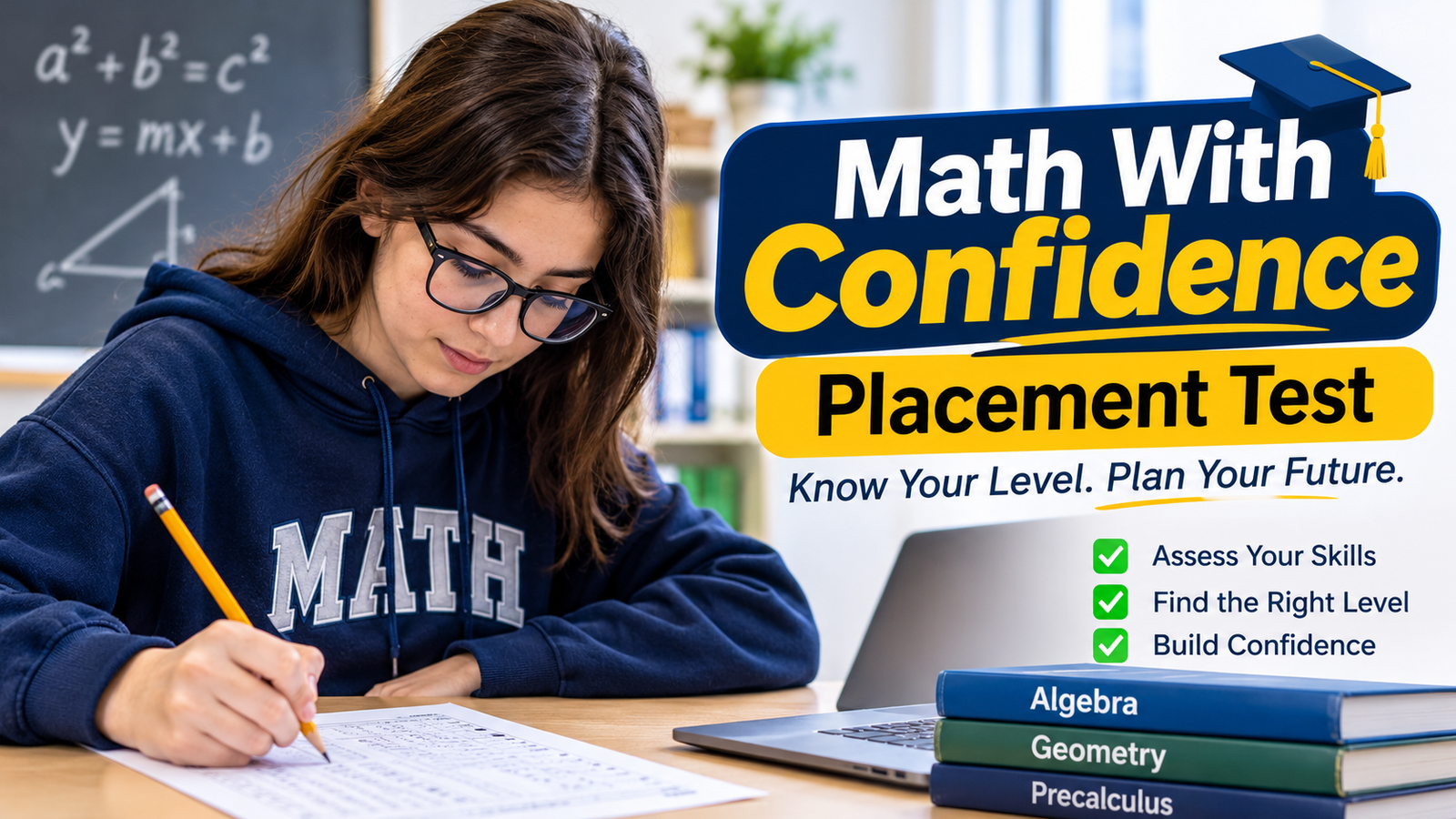
The Math with Confidence placement test is a skill-based guide that helps parents choose the appropriate homeschool math level for their children. Rather than relying only on age or school grade, parents should evaluate what their child already knows and can do independently.
Math with Confidence, created by homeschool educator Kate Snow, does not use a traditional formal placement test. Instead, it provides a placement checklist that helps families identify the most suitable starting level, from Kindergarten through the elementary grades.
Choosing the right level is important because children learn mathematics at different speeds. Starting at an appropriate level allows students to strengthen existing skills, understand new concepts, and develop confidence without unnecessary frustration.
What Is the Math With Confidence Placement Test?
Math with Confidence is a homeschool mathematics curriculum designed to teach essential math skills through short lessons, hands-on activities, games, and workbook exercises.
Its placement process is different from a conventional examination. Parents use a checklist to review their child’s existing mathematical knowledge and determine which level is appropriate.
The checklist focuses on skills such as:
- Counting and number recognition.
- Writing and comparing numbers.
- Addition and subtraction.
- Understanding place value.
- Multiplication and division.
- Fractions and other age-appropriate mathematical concepts.
The general recommendation is to choose the highest level for which the child can demonstrate the required prerequisite skills confidently.
This approach helps parents avoid placing children in a course that is either too difficult or unnecessarily repetitive.
How to Choose the Correct Math With Confidence Level
The official placement guidance recommends checking prerequisite skills rather than automatically choosing a level based on age. Most children can begin around their current school grade, but their mathematical understanding should determine the final decision.
Here is an overview of the skills parents should assess.
Kindergarten Math With Confidence
Most children are ready for Kindergarten Math with Confidence at around five or six years old.
Helpful starting skills include:
- Counting to 10.
- Holding a pencil comfortably.
- Showing interest in numbers and basic counting activities.
These are helpful readiness skills, not strict admission requirements. Children do not need to complete a formal preschool math curriculum first.
First Grade Math With Confidence
Before beginning first grade, a child should generally be able to:
- Count to at least 10, preferably higher.
- Write numbers from 1 to 10.
- Recognize basic shapes, including circles, triangles, and squares.
- Solve simple addition and subtraction word problems using physical objects.
A child who has not completed a formal kindergarten math curriculum may still be ready for first grade if these skills are established.
Second Grade Math With Confidence
Important prerequisite skills include:
- Counting to 100 by ones, twos, fives, and tens.
- Reading, writing, and comparing two-digit numbers.
- Understanding tens and ones in place value.
- Writing simple addition and subtraction equations.
- Solving basic single-digit addition and subtraction word problems.
- Knowing most addition facts up to 9 + 9.
- Knowing most subtraction facts involving numbers up to 10.
Children should demonstrate a reasonable understanding of these concepts before moving into second grade.
Third Grade Math With Confidence
Before starting third grade, children should generally be comfortable with:
- Counting by ones, twos, fives, and tens up to 1,000.
- Reading, writing, and comparing three-digit numbers.
- Understanding place value in three-digit numbers.
- Performing basic addition and subtraction.
- Solving multiplication and division problems appropriate to their previous instruction.
A solid foundation in number relationships is particularly important at this stage.
Fourth Grade Math With Confidence
Fourth-grade readiness involves more advanced arithmetic and problem-solving skills.
Children should generally be able to:
- Read, write, compare, and understand place value in numbers up to 10,000.
- Add and subtract four-digit numbers using traditional written methods.
- Recall most multiplication and division facts up to 10 × 10.
- Solve word problems involving all four basic operations.
- Work with two-step word problems.
- Calculate the area and perimeter of rectangles.
- Read, write, and compare simple fractions.
A child who understands these concepts but needs more multiplication practice may still be ready for fourth grade.
Fifth Grade Math With Confidence
Fifth-grade readiness requires a stronger understanding of multiplication, division, fractions, and decimals.
The recommended prerequisite skills include:
- Understanding place value up to 1,000,000.
- Recalling most multiplication and division facts.
- Multiplying multi-digit numbers using written methods.
- Dividing numbers up to four digits by one-digit numbers.
- Finding equivalent fractions.
- Converting improper fractions into mixed numbers and vice versa.
- Adding and subtracting fractions with like denominators.
- Reading, writing, and comparing decimals to the hundredths place.
- Converting measurements within the same measurement system.
- Measuring and comparing angles.
Sixth Grade Math With Confidence
Sixth-grade students should have a strong foundation in arithmetic and fractions.
Important prerequisite skills include:
- Multiplying whole numbers up to three digits by two digits.
- Dividing four-digit numbers by two-digit numbers.
- Finding a fraction of a set or measurement.
- Adding and subtracting fractions with different denominators.
- Multiplying fractions and mixed numbers.
- Reading, writing, comparing, and ordering decimals to the thousandths place.
- Adding and subtracting decimals to the thousandths place.
- Multiplying and dividing decimals by whole numbers.
- Finding the volume of a rectangular prism.
- Calculating the mean and median of a small data set.
These are minimum readiness expectations, not a complete list of everything taught in each grade.
How to Use the Placement Checklist
Parents can make the placement process easier by following a simple assessment routine.
Review the previous math skills
Start by identifying what your child has already learned. Consider school lessons, previous homeschool programs, worksheets, and everyday mathematical activities.
Check understanding rather than memorization
Ask your child to explain how they solve a problem. A child who understands why an answer is correct is generally better prepared than one who simply remembers a procedure.
Use practical examples
Use counters, coins, household objects, drawings, or written exercises to assess mathematical understanding. Practical activities can make it easier to identify gaps in knowledge.
Compare skills with the official checklist
Review the prerequisites for each Math with Confidence level. Look for the highest level at which your child demonstrates the required foundation.
Choose a comfortable starting point
If your child struggles with several important prerequisite skills, consider starting at a lower level. A strong foundation is more valuable than rushing into advanced material.
What Should Parents Do If a Child Struggles With the Placement Skills?
If a child struggles with a few prerequisite skills, parents do not necessarily need to move down an entire grade level.
First, identify the specific areas causing difficulty. For example, a child might understand addition, subtraction, and place value but struggle with multiplication facts.
In this situation, parents can provide additional practice in the weaker areas while continuing to develop the skills the child already understands.
However, if several foundational concepts are missing, choosing an earlier level may provide a more comfortable learning experience.
The Math with Confidence approach also encourages parents to adjust lesson pacing according to their child’s needs.
Why Choosing the Right Placement Level Matters
Selecting the correct mathematics level can make homeschooling more productive and enjoyable.
Some important benefits include:
- Stronger foundations: Children develop essential mathematical skills before moving to more advanced concepts.
- Better understanding: Students have opportunities to understand mathematical ideas instead of simply memorizing answers.
- Less frustration: Appropriate difficulty levels help prevent children from feeling overwhelmed.
- Improved confidence: Successfully completing lessons encourages children to approach new challenges.
- Flexible learning: Parents can adjust lesson speed according to individual progress.
The goal is not to place children in the highest possible grade. It is to provide instruction that matches their current abilities.
Frequently Asked Questions
Does Math with Confidence have an official placement test?
Math with Confidence does not offer a traditional formal placement examination. Instead, Kate Snow provides a readiness checklist that parents can use to identify the appropriate starting level.
What age should a child start Math with Confidence?
Most children are ready for Kindergarten Math with Confidence around five or six years old. However, readiness and existing mathematical skills are more important than age alone.
Can my child skip a Math with Confidence grade?
Yes. Children do not necessarily need to complete every previous level. Parents can use the placement checklist to determine whether their child already understands the required prerequisite skills.
What should I do if my child does not meet all the placement requirements?
Identify the missing skills and provide additional practice. If several important prerequisites are missing, consider beginning with an earlier level to strengthen the child’s foundation.
Is Math with Confidence suitable for homeschool students?
Yes. Math with Confidence is specifically designed as a homeschool mathematics curriculum. It includes instructor guides, student workbooks, hands-on activities, and games.
Does Math with Confidence cover all elementary grades?
The curriculum offers levels from Kindergarten through Sixth Grade. Each level covers age-appropriate mathematical concepts and builds on previously developed skills.
Conclusion
The Math with Confidence placement test is best understood as a readiness checklist rather than a traditional examination. It helps parents evaluate their children’s existing mathematical knowledge and select an appropriate starting level.
By considering prerequisite skills, understanding individual learning needs, and providing additional practice when necessary, parents can create a more effective homeschool mathematics experience.
The most important consideration is choosing a level where children can build strong foundations, understand new concepts, and develop lasting confidence in mathematics.
Also read: All About Reading Level 3

1 Comment
Pingback: Is Vat19 Legit? A Complete Review of the Online Store