
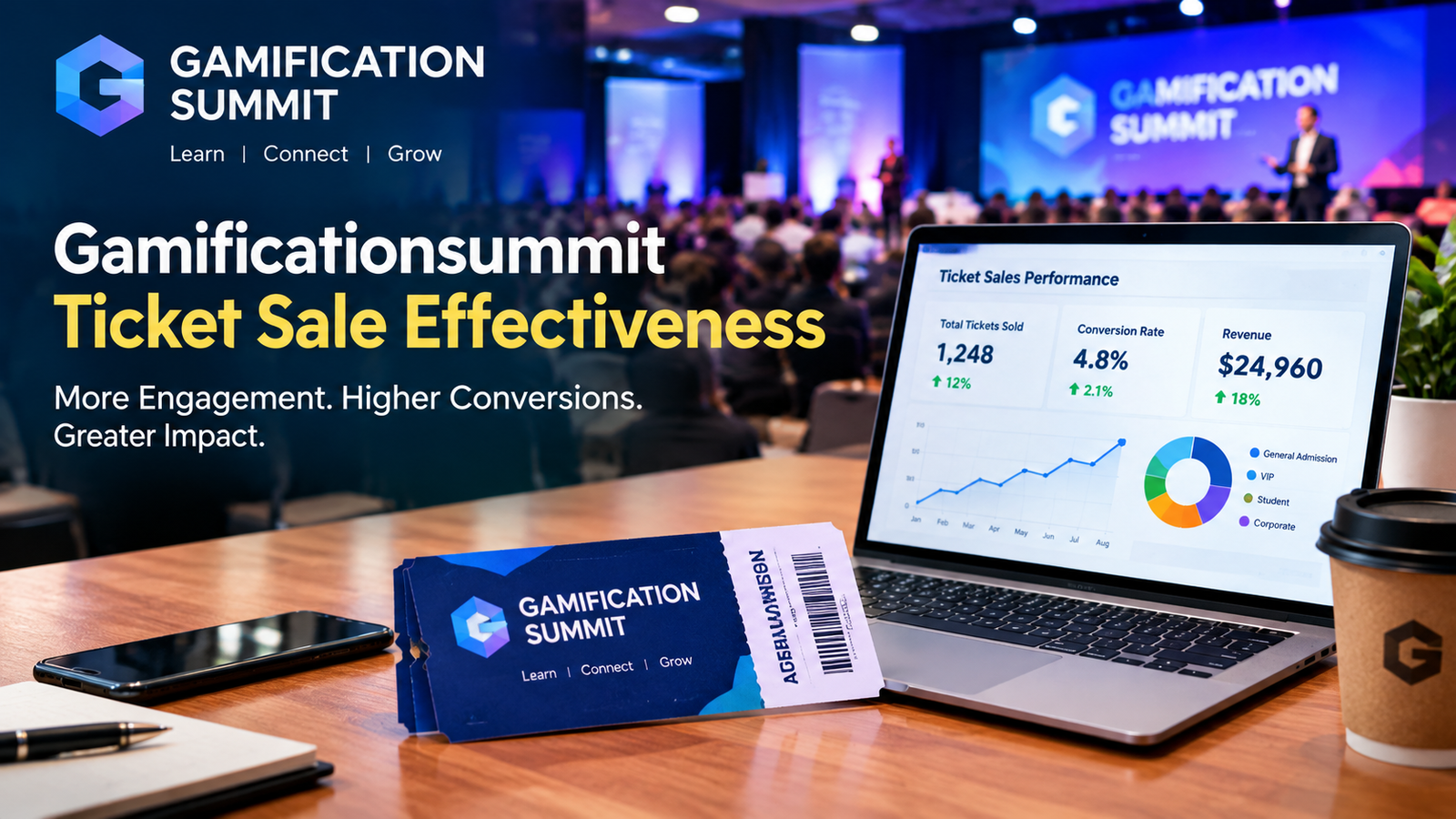
Gamificationsummit ticket sale effectiveness refers to how successfully a gamification-focused summit turns audience interest into paid registrations while controlling marketing costs and delivering a smooth buying experience. The most reliable way to evaluate it is to measure ticket conversion rates, revenue, marketing return, referral sales, and checkout completion rather than relying on ticket counts alone.
For event organizers, improving ticket sales requires more than discounts or promotional campaigns. A clear event offer, relevant marketing, transparent pricing, convenient payment options, and consistent performance tracking can help convert interested visitors into confirmed attendees. However, claims about a specific summit’s sales performance should be supported by verifiable event records rather than assumed results.
What Does Gamificationsummit Ticket Sale Effectiveness Mean?
Gamificationsummit ticket sale effectiveness can be understood as the performance of the marketing and registration process used to sell tickets for a gamification-focused event. It includes how many potential attendees become buyers, how much revenue each ticket generates, and how efficiently organizers use their promotional budgets.
The phrase can also refer to broader strategies for improving ticket sales at conferences about gamification. These events may attract professionals working in game design, digital marketing, education, employee engagement, user experience, and product development. However, the exact meaning depends on whether the search refers to a specific event or to ticket-selling methods for gamification summits generally.
An important research limitation: Online pages use similar versions of this keyword, but the available material does not independently establish audited ticket-sales figures, verified attendance totals, or measured conversion improvements for a specific GamificationSummit event. Therefore, numerical claims about that event should not be treated as confirmed results without supporting records.
Why Ticket Sale Effectiveness Matters
Ticket sales influence an event’s financial position, audience size, and ability to deliver its planned program. Strong sales can help organizers forecast attendance, arrange venues, coordinate speakers, and manage event expenses more accurately.
Measuring effectiveness also reveals problems that total ticket sales alone cannot show. An event might sell many tickets but spend too much on advertising to make a profit. Another event might sell fewer tickets while attracting a highly relevant professional audience at a lower acquisition cost.
Organizers should evaluate both sales volume and sales quality. This means understanding where buyers come from, what motivates them to register, and which parts of the purchasing process prevent interested visitors from completing their orders.
Key Metrics for Measuring Gamificationsummit Ticket Sale Effectiveness
A practical measurement system should focus on a small number of meaningful indicators. These metrics help organizers compare marketing channels, identify checkout problems, and decide where to invest their time and budget.
| Metric | What it measures | Why it matters |
|---|---|---|
| Ticket conversion rate | Percentage of relevant website visitors who purchase tickets | Shows how effectively the sales page turns interest into purchases |
| Total tickets sold | Number of completed ticket purchases or tickets issued | Tracks progress toward attendance targets |
| Revenue per ticket | Ticket revenue divided by tickets sold | Helps evaluate pricing and the mix of ticket types |
| Customer acquisition cost | Marketing and sales costs divided by acquired buyers | Shows how much it costs to attract each customer |
| Checkout abandonment | Percentage of checkout starters who do not complete a purchase | Helps identify payment or registration friction |
| Referral sales | Purchases attributed to attendee or partner referrals | Measures the contribution of word-of-mouth promotion |
| Return on marketing spend | Revenue attributed to marketing divided by marketing expenditure | Helps compare campaign performance |
These indicators should be interpreted together. For example, a campaign may increase website traffic without improving purchases, suggesting that the audience is poorly targeted or the offer is unclear.
How to Calculate Ticket Conversion Rate
Ticket conversion rate is the proportion of eligible visitors who complete a purchase during a defined measurement period.
The basic formula is:
\[ \text{Conversion Rate}= \frac{\text{Purchasing Visitors}}{\text{Total Eligible Visitors}} \times100 \]
For example, if 2,000 eligible visitors reach a ticket page and 80 unique visitors purchase tickets, the conversion rate is 4%.
This is an illustrative calculation, not a reported GamificationSummit result. Organizers should define whether they count unique purchasing visitors, transactions, or individual tickets, because these measures can produce different percentages.
How to Measure Marketing Return
Return on marketing spend compares the revenue attributed to a campaign with the cost of running it.
\[ \text{ROAS}= \frac{\text{Attributed Ticket Revenue}}{\text{Advertising Cost}} \]
If a campaign generates $6,000 in attributed ticket revenue from $1,500 in advertising, its return on advertising spend is 4x. This does not automatically mean the campaign is profitable because venue hire, payment processing, staff, refunds, and other event expenses may still need to be covered.
For a more complete assessment, organizers should also calculate profit after relevant costs and consider whether ticket sales would have occurred without the campaign.
How Gamification Can Improve Ticket Sales
Gamification means applying game-inspired features to activities that are not traditionally games. Common examples include points, badges, progress indicators, challenges, levels, and leaderboards. A systematic mapping study published in 2019 examined the use of these mechanics across existing research, demonstrating that gamification is an established area of study rather than simply a promotional buzzword.
PMC
+1
For a summit, these elements can be incorporated into pre-event promotion, registration, and attendee engagement. Their effectiveness depends on the audience, the design, the value of the reward, and whether the activity makes registration more appealing rather than more complicated.
1. Early-Bird Ticket Offers
Early-bird pricing gives attendees an opportunity to purchase tickets at a lower price before a clearly stated deadline. It can encourage people who are already interested to commit earlier, helping organizers estimate demand and plan event operations.
The offer should explain the normal price, discounted price, deadline, and benefits included. Organizers should avoid repeatedly extending deadlines or advertising false scarcity because these practices can undermine trust.
Early-bird sales should be measured by the number of tickets sold during the promotional period, the revenue generated, and the proportion of buyers who would otherwise have purchased later at full price.
2. Referral Rewards
Referral programs encourage existing attendees, speakers, partners, or community members to introduce the event to potential buyers. Organizers may use referral codes, trackable links, group discounts, or clearly defined rewards.
A successful program should generate additional purchases rather than simply reward people who would have bought tickets anyway. Unique tracking links and referral codes can help distinguish new sales from existing demand.
The most useful measures are referred ticket purchases, cost per referred buyer, and the percentage of referrals that result in completed transactions. Rewards should also be clearly disclosed and governed by straightforward terms.
3. Interactive Pre-Event Challenges
Organizers can use quizzes, speaker-related challenges, short learning activities, or event-themed competitions to encourage participation before registration opens. For example, a summit focused on workplace learning could offer a short gamification quiz and share educational results with participants.
These activities can help build an interested audience, but participation is not the same as purchase intent. A campaign should connect its activities to a relevant event benefit and measure how many participants subsequently visit the ticket page and register.
Research reviews have found that gamification can support engagement in some settings, while effects may vary and decline as novelty wears off. It is therefore important to test individual campaign elements rather than assume that adding points or badges will automatically increase sales.
PMC
+1
4. Progress Indicators and Registration Rewards
A progress indicator can show buyers how far they have advanced through registration. Clear steps, immediate feedback, and useful confirmation messages can make a process easier to understand.
Rewards may also be offered for legitimate actions, such as completing a voluntary pre-event survey or participating in an educational challenge. However, essential purchase information should remain accessible without forcing buyers to complete unrelated tasks.
The goal is to make registration feel straightforward and rewarding, not to add unnecessary steps. Organizers should compare completion rates and user feedback before and after introducing a new feature.
How to Improve the Ticket-Buying Experience
A strong promotional campaign can still underperform if the ticket page is confusing or the checkout process fails. Organizers should make the purchase journey clear from the first visit through to the confirmation message.
Write a Clear Event Description
The event page should immediately explain what the summit covers, who should attend, and what participants can expect to learn. Include the agenda when available, speaker information, event format, venue or online access details, and the date.
Potential buyers need enough information to decide whether the event is relevant to their professional or personal goals. Specific outcomes are generally more useful than broad statements promising an exceptional or transformative experience.
Keep Ticket Options Simple
Ticket categories should be easy to compare. If an event offers standard, premium, or group tickets, explain the differences in access, sessions, materials, or other included benefits.
Unclear package descriptions can create hesitation and increase the likelihood that visitors leave without purchasing. Organizers should avoid adding ticket tiers unless each option serves a distinct audience need.
Optimize Mobile Registration
Visitors should be able to read ticket details, select an option, enter their information, and complete payment on a mobile device. Buttons should be easy to use, form fields should request only necessary information, and error messages should explain how to fix a problem.
Test the complete purchasing process on common mobile and desktop devices. Verify that payment succeeds, ticket inventory updates correctly, and confirmation emails contain the information attendees need.
Build Trust Before Payment
Buyers should be able to identify the event organizer and understand the ticket terms before paying. Display accurate contact details, refund or cancellation conditions, payment information, and any relevant accessibility guidance.
Do not use invented testimonials, fabricated attendee numbers, or unsupported claims about how quickly tickets are selling. Trustworthy information supports informed decisions and protects the event’s reputation.
The Role of Marketing Channels in Ticket Sales
Effective ticket promotion depends on reaching people who have a genuine reason to attend. Organizers should choose channels based on the intended audience and measure completed purchases, not just views or likes.
- Email marketing: Share event announcements, agenda updates, registration deadlines, and relevant reminders with people who have consented to receive communications.
- Professional networks: Use channels such as LinkedIn to reach people working in gamification, product management, learning and development, marketing, or user experience.
- Industry communities: Work with relevant professional groups, newsletters, associations, and community organizers where event promotion is permitted.
- Social media: Publish useful speaker insights, short educational posts, event updates, and registration information.
- Partnerships: Collaborate with organizations whose audiences overlap with the summit’s intended attendees.
- Paid advertising: Test targeted campaigns with clear tracking and defined spending limits.
Campaign attribution is essential when several channels work together. A visitor may first discover an event through social media, return through email, and eventually purchase after receiving a reminder. Measuring only the final click can overlook the contribution of earlier interactions.
Common Problems That Reduce Ticket Sale Effectiveness
Several preventable issues can weaken ticket sales even when the event itself offers valuable content.
Unclear value proposition: If visitors cannot understand why they should attend, they may postpone their decision or choose another event. The page should explain the benefits in concrete terms.
Poorly targeted advertising: Broad campaigns can generate traffic from people who have little interest in the subject. Audience relevance and completed registrations are more useful indicators than impressions alone.
Complicated checkout: Long forms, unclear fees, payment errors, and unsupported payment methods can interrupt purchases. A test purchase can reveal problems before the campaign reaches its busiest period.
Discount dependence: Repeated discounts can reduce revenue per ticket and train customers to wait for another offer. Discounts should have a defined purpose and measurable effect.
Overuse of gamification: Points, rankings, or challenges may distract from the event’s actual value if they do not support a clear objective. Gamification research emphasizes that results vary by context and implementation.
PMC
+1
Insufficient measurement: Without tracking, organizers may continue spending on ineffective channels or overlook problems on the ticket page. Establish baseline metrics before changing the campaign.
A Practical Framework for Evaluating Gamificationsummit Ticket Sale Effectiveness
Organizers can evaluate performance using a straightforward process that connects campaign activity to sales outcomes.
- Set measurable targets. Define the desired ticket volume, revenue, campaign budget, and registration deadline before launching promotions.
- Establish a baseline. Record existing traffic, conversion rates, sales by channel, average ticket revenue, and checkout completion.
- Identify the biggest obstacle. Determine whether the main issue is low traffic, weak purchase intent, unclear pricing, or checkout friction.
- Test one meaningful change. Compare a revised headline, simpler ticket selection, a different email message, or a relevant referral offer while keeping other factors as consistent as possible.
- Evaluate the results. Compare completed purchases, revenue, acquisition costs, and any negative effects on the attendee experience.
- Apply the findings. Retain changes that deliver a meaningful improvement and continue monitoring performance through the end of the sales period.
A measurement dashboard can make this process easier. Analytics tools, advertising reports, email platforms, and ticketing records should use consistent campaign names and tracking conventions so results can be compared accurately.
What Is Verified About GamificationSummit Ticket Sales?
Search results contain articles specifically discussing GamificationSummit ticket-sale effectiveness, including pages published on sites using names such as Gamificationsummits.com and Gamificationsummit.net. These pages discuss early-bird offers, referral programs, gamified registration, and performance measurement.
Gamificationsummits.com
+2
However, the existence of articles discussing an event’s strategy does not independently verify that the described campaign took place or produced the reported outcomes. The available search evidence does not establish independently audited sales totals, a verified year-over-year comparison, or a documented causal link between a particular gamification feature and ticket revenue.
Readers researching a specific summit should therefore look for primary evidence, such as an official event page, a dated ticketing announcement, a published organizer report, or a case study that explains its data collection and measurement methods. Until those records are available, claims about specific sales increases or referral percentages should be treated as unverified.
This distinction matters because general evidence that gamification can influence engagement does not prove that a particular event used it successfully to sell tickets.
Frequently Asked Questions
1. What is gamificationsummit ticket sale effectiveness?
It describes how effectively a gamification-focused summit converts interested people into confirmed ticket buyers. Relevant measures include conversion rate, ticket revenue, marketing costs, referral purchases, and checkout completion.
2. How can gamification increase event ticket sales?
Gamification can encourage participation through challenges, rewards, progress indicators, and referral incentives. Its impact should be measured using completed purchases and revenue rather than engagement alone.
3. Which metrics matter most for event ticket sales?
Ticket conversion rate, total tickets sold, revenue per ticket, customer acquisition cost, and return on advertising spend are useful starting points. Checkout abandonment and referral sales can provide additional insight into specific parts of the sales process.
4. Do early-bird discounts improve ticket sales?
They can encourage earlier purchasing by offering a clear financial benefit before a stated deadline. Their effectiveness depends on audience demand, pricing, and whether the additional early sales justify the discount.
5. Is there verified data proving GamificationSummit increased ticket sales through gamification?
The available research does not independently verify specific sales increases for a particular GamificationSummit event. Reported figures should be checked against primary records or a transparent, independently verifiable case study.
6. How can organizers improve ticket sales without increasing advertising costs?
They can improve event-page clarity, simplify checkout, communicate relevant attendee benefits, strengthen permission-based email follow-ups, and track referral performance. Testing these changes helps identify improvements that do not depend on additional advertising expenditure.
Also read: Howard Schultz and George Soros
